
forum4travel

Let me be straight with you. I've walked into Base Camp more times than I can count on both hands, and I still get a knot in my stomach somewhere around Dingboche. That feeling never fully goes away, and if you're smart, it shouldn't.
Forget what the brochures tell you. This isn't a "bucket list adventure" you check off in a week and forget. It's 12 to 14 days of walking uphill on legs that get less oxygen every single day. You'll sleep in teahouses where the water in your bottle freezes solid overnight. You'll learn things about your own body you didn't know before you started.
Here's the thing people get wrong about the nepal everest base camp trek: it's not a fitness test. You don't need to be an athlete. What you need is patience, a stubborn streak, and enough respect for altitude to slow down when your body tells you to. Nail those three things and the mountain will treat you fair. Ignore them and it won't matter how strong your legs are.
The trek sits entirely inside Sagarmatha National Park, a UNESCO World Heritage Site that starts just above Monjo and stretches all the way to the Tibetan border. You'll pay a park entry fee at the checkpoint there, and a ranger will actually stamp your permit book by hand.
The Khumbu is Sherpa homeland, and that matters more than trekking blogs usually admit. The stone-walled fields, the mani walls you should always pass on the left, the prayer flags strung across every ridge. None of that is set dressing. It's a living culture that happens to sit at 3,400 to 5,364 meters.
Namche Bazaar is the region's beating heart, a horseshoe-shaped town carved into a hillside that somehow has bakeries, a Saturday market, and better espresso than my hometown. Above Namche, trees thin out fast. By Dingboche, you're in high alpine desert. Rock, scrub, and wind.
The trail itself follows the Dudh Kosi river valley for the first few days, crossing it repeatedly on steel suspension bridges strung with tattered flags. The highest and most dramatic of these, the Hillary Bridge above Namche, sits about 125 meters above the river. Don't look down if heights bother you. Just keep your eyes on the person ahead of you and walk.
Notice the two dedicated acclimatization days. Cutting either of those to save a day is the single most common mistake I see, and it's the reason so many trekkers end up being evacuated by helicopter from Pheriche.
Guide's Pro-Tip: The climb from Phakding to Namche is where I've seen more people quietly question their fitness than anywhere else on the trail. It's a relentless 700-meter gain over roughly 3-4 hours, much of it on a single exposed switchback above the river gorge. Go slow here even if you feel strong. This is not the hill to prove anything on.
Base Camp itself, when you arrive, is honestly a bit anticlimactic in spring: a scattered field of rock and ice with a cairn of prayer flags marking the spot, and no view of Everest's summit from where you stand. The mountain hides behind Nuptse. What you can see, if you look toward the Khumbu icefall, is the tumbling, shifting wall of seracs that climbers heading for the summit have to navigate before dawn, when the ice is coldest and least likely to shift underfoot.
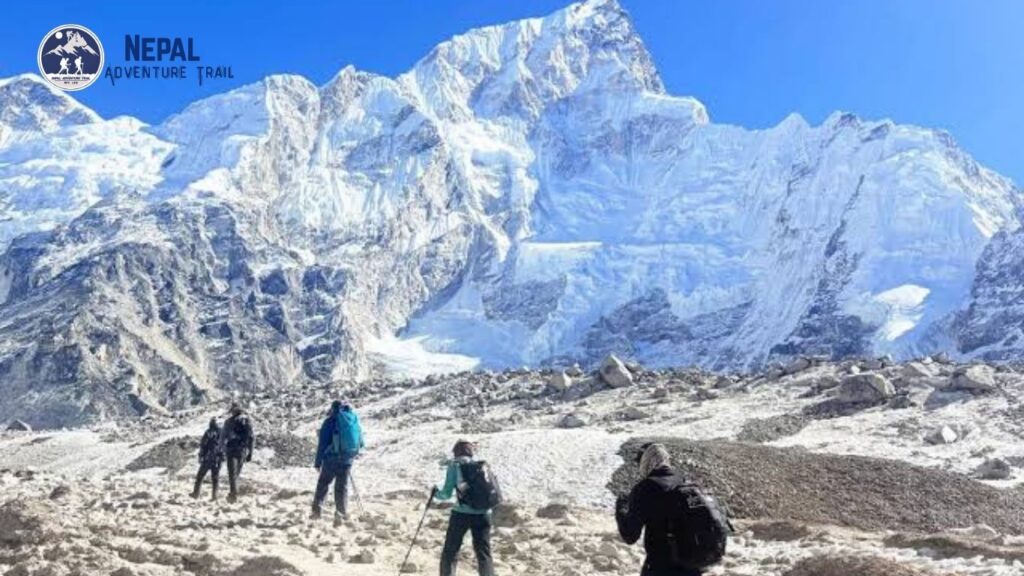 Every step counts: A trekker traverses the rugged landscape of the Khumbu region during a professional Nepal Everest Base Camp trek.
People ask me how to prepare for Everest base camp trek season after season, and the answer disappoints them because it's not glamorous: cardiovascular endurance beats gym strength every time.
You need legs that can carry you uphill for 5-7 hours a day, repeatedly, for nearly two weeks. Squats and lunges help. Stair climbing with a loaded pack helps more. If you have access to a StairMaster, spend three months putting in hour-long sessions with 15-20kg on your back.
Here's what altitude actually feels like, since nobody tells you straight: at 5,000 meters, the air holds roughly half the oxygen it does at sea level. You'll notice it first as a mild headache and shortness of breath on stairs you'd normally jog up. Push through the wrong way and it graduates to nausea, disorientation, and a pounding skull that no painkiller fixes. That's your body telling you to descend, not push on.
This is why acclimatization in the Khumbu follows a strict rule locals have known for generations: climb high, sleep low. You gain altitude during the day, then drop back down to sleep at a lower elevation, letting your body build red blood cells gradually rather than shocking it.
Start a cardio program at least 8-10 weeks out. Include hikes on consecutive days to simulate cumulative fatigue, because that's what actually breaks people on this trek. Not any single day, but day nine on legs that haven't fully recovered from day eight.
Let's talk paperwork, because Nepal Everest base camp trek cost and permits confuse almost everyone on their first attempt.
Permits you'll need:
Budget realistically for Nepal Everest Base Camp Trek:
Altitude safety comes down to Diamox as a preventive aid (discuss with a doctor before you go), a pulse oximeter to track your blood oxygen daily, and an honest conversation with your guide the moment you feel off. Every reputable operator should also carry a Gamow bag or arrange helicopter evacuation insurance as standard practice during the Nepal Everest Base Camp Trek.
Forget generic packing lists. Here's what matters based on two decades of watching what people actually use versus what sits dead weight in their duffel:
Can I do solo trekking on this route anymore?
No, Nepal requires all foreign trekkers to hire a licensed guide for this route. This was introduced after search-and-rescue incidents involving unaccompanied trekkers.
Is the water safe to drink?
Not from taps or streams. Use purification tablets, a UV filter, or buy boiled water at teahouses. Expect to pay more the higher you climb.
How do I charge my devices?
Solar charging is unreliable in cloud cover, which is common. A quality power bank plus paid charging at teahouses is the realistic answer.
What insurance do I actually need?
Get a policy that explicitly covers high-altitude trekking up to 6,000 meters and helicopter evacuation. Read the fine print. Many standard travel policies cap coverage at 3,000-4,000 meters, which is useless here.
What's the best time to trek Everest?
Pre-monsoon (late March to May) and post-monsoon (late September to November) are the two reliable windows. Winter is possible but brutally cold; monsoon season brings leech-heavy trails and grounded flights.
How hard is the Everest base camp trek difficulty, honestly?
It's a long-distance endurance challenge at altitude, not a technical climb. The difficulty comes almost entirely from oxygen deprivation and cumulative fatigue, not terrain.
The Nepal Everest Base Camp trek is a serious undertaking that requires more than just fitness; it requires careful logistical planning. At Nepal Adventure Trail, we specialize in the specific nuances of the Khumbu region, from securing your Lukla flights to managing your acclimatization schedule. Contact us to ensure your expedition is as safe as it is rewarding.
Forget what the brochures tell you. This isn't a "bucket list adventure" you check off in a week and forget. It's 12 to 14 days of walking uphill on legs that get less oxygen every single day. You'll sleep in teahouses where the water in your bottle freezes solid overnight. You'll learn things about your own body you didn't know before you started.
Here's the thing people get wrong about the nepal everest base camp trek: it's not a fitness test. You don't need to be an athlete. What you need is patience, a stubborn streak, and enough respect for altitude to slow down when your body tells you to. Nail those three things and the mountain will treat you fair. Ignore them and it won't matter how strong your legs are.
Geography & The Khumbu Experience
The trek sits entirely inside Sagarmatha National Park, a UNESCO World Heritage Site that starts just above Monjo and stretches all the way to the Tibetan border. You'll pay a park entry fee at the checkpoint there, and a ranger will actually stamp your permit book by hand.
The Khumbu is Sherpa homeland, and that matters more than trekking blogs usually admit. The stone-walled fields, the mani walls you should always pass on the left, the prayer flags strung across every ridge. None of that is set dressing. It's a living culture that happens to sit at 3,400 to 5,364 meters.
Namche Bazaar is the region's beating heart, a horseshoe-shaped town carved into a hillside that somehow has bakeries, a Saturday market, and better espresso than my hometown. Above Namche, trees thin out fast. By Dingboche, you're in high alpine desert. Rock, scrub, and wind.
The trail itself follows the Dudh Kosi river valley for the first few days, crossing it repeatedly on steel suspension bridges strung with tattered flags. The highest and most dramatic of these, the Hillary Bridge above Namche, sits about 125 meters above the river. Don't look down if heights bother you. Just keep your eyes on the person ahead of you and walk.
The "Nepal Everest Base Camp Trek" Itinerary: A Guide's Perspective
Here's the itinerary I actually run, not the compressed version travel agencies advertise to look cheaper:- Day 1-2: Fly Kathmandu to Lukla (2,860m), trek to Phakding (2,610m)
- Day 3: Phakding to Namche Bazaar (3,440m), the brutal climb
- Day 4: Acclimatization day in Namche, hike to Everest View Hotel
- Day 5: Namche to Tengboche (3,860m), home to a stunning monastery
- Day 6: Tengboche to Dingboche (4,410m)
- Day 7: Acclimatization day in Dingboche, hike to Nangkartshang
- Day 8: Dingboche to Lobuche (4,940m)
- Day 9: Lobuche to Gorak Shep (5,164m), then push to Everest Base Camp (5,364m) and back
- Day 10: Gorak Shep to Kala Patthar (5,545m) at sunrise, then descend to Pheriche
- Day 11-12: Descend back to Lukla via Namche
- Day 13-14: Fly to Kathmandu (buffer day always built in)
Notice the two dedicated acclimatization days. Cutting either of those to save a day is the single most common mistake I see, and it's the reason so many trekkers end up being evacuated by helicopter from Pheriche.
Guide's Pro-Tip: The climb from Phakding to Namche is where I've seen more people quietly question their fitness than anywhere else on the trail. It's a relentless 700-meter gain over roughly 3-4 hours, much of it on a single exposed switchback above the river gorge. Go slow here even if you feel strong. This is not the hill to prove anything on.
Base Camp itself, when you arrive, is honestly a bit anticlimactic in spring: a scattered field of rock and ice with a cairn of prayer flags marking the spot, and no view of Everest's summit from where you stand. The mountain hides behind Nuptse. What you can see, if you look toward the Khumbu icefall, is the tumbling, shifting wall of seracs that climbers heading for the summit have to navigate before dawn, when the ice is coldest and least likely to shift underfoot.
Physical Preparation: What You Actually Need
People ask me how to prepare for Everest base camp trek season after season, and the answer disappoints them because it's not glamorous: cardiovascular endurance beats gym strength every time.
You need legs that can carry you uphill for 5-7 hours a day, repeatedly, for nearly two weeks. Squats and lunges help. Stair climbing with a loaded pack helps more. If you have access to a StairMaster, spend three months putting in hour-long sessions with 15-20kg on your back.
Here's what altitude actually feels like, since nobody tells you straight: at 5,000 meters, the air holds roughly half the oxygen it does at sea level. You'll notice it first as a mild headache and shortness of breath on stairs you'd normally jog up. Push through the wrong way and it graduates to nausea, disorientation, and a pounding skull that no painkiller fixes. That's your body telling you to descend, not push on.
This is why acclimatization in the Khumbu follows a strict rule locals have known for generations: climb high, sleep low. You gain altitude during the day, then drop back down to sleep at a lower elevation, letting your body build red blood cells gradually rather than shocking it.
Start a cardio program at least 8-10 weeks out. Include hikes on consecutive days to simulate cumulative fatigue, because that's what actually breaks people on this trek. Not any single day, but day nine on legs that haven't fully recovered from day eight.
The Logistics: Permits, Flights, and Altitude Safety
Let's talk paperwork, because Nepal Everest base camp trek cost and permits confuse almost everyone on their first attempt.
Permits you'll need:
- Sagarmatha National Park entry permit (approx. $30 USD)
- Khumbu Pasang Lhamu Rural Municipality entry permit (approx. $20 USD)
- TIMS card is no longer required for this specific route as of recent regulation changes, though this shifts periodically, so confirm before you fly
Budget realistically for Nepal Everest Base Camp Trek:
- Lukla round-trip flight: $340-400 USD
- Teahouse lodging: often free or $2-5/night if you eat dinner and breakfast there
- Meals: $25-40 USD per day as you climb higher (prices rise with altitude since everything is carried in by porter or yak)
- A licensed guide and/or porter: legally required for non-Nepali trekkers as of the 2023 solo trekking ban
Altitude safety comes down to Diamox as a preventive aid (discuss with a doctor before you go), a pulse oximeter to track your blood oxygen daily, and an honest conversation with your guide the moment you feel off. Every reputable operator should also carry a Gamow bag or arrange helicopter evacuation insurance as standard practice during the Nepal Everest Base Camp Trek.
EBC Packing Strategy: Beyond the Brochure
Forget generic packing lists. Here's what matters based on two decades of watching what people actually use versus what sits dead weight in their duffel:
- Sleeping bag rated to -20°C: teahouse blankets are not enough above Dingboche
- Down jacket: temperatures at Gorak Shep regularly drop below -15°C at night
- Broken-in hiking boots: never trek in new boots; blisters at altitude become infected wounds fast
- Water purification tablets or a UV filter: boiled water is available but costs money at every teahouse
- A physical battery pack (10,000mAh minimum): charging costs $3-5 USD per device above Namche, and outlets are unreliable
- Diamox, ibuprofen, and rehydration salts: non-negotiable in your first aid kit
- Trekking poles: your knees will thank you on the descent through Namche, which is steeper than people expect going down
FAQS
Can I do solo trekking on this route anymore?
No, Nepal requires all foreign trekkers to hire a licensed guide for this route. This was introduced after search-and-rescue incidents involving unaccompanied trekkers.
Is the water safe to drink?
Not from taps or streams. Use purification tablets, a UV filter, or buy boiled water at teahouses. Expect to pay more the higher you climb.
How do I charge my devices?
Solar charging is unreliable in cloud cover, which is common. A quality power bank plus paid charging at teahouses is the realistic answer.
What insurance do I actually need?
Get a policy that explicitly covers high-altitude trekking up to 6,000 meters and helicopter evacuation. Read the fine print. Many standard travel policies cap coverage at 3,000-4,000 meters, which is useless here.
What's the best time to trek Everest?
Pre-monsoon (late March to May) and post-monsoon (late September to November) are the two reliable windows. Winter is possible but brutally cold; monsoon season brings leech-heavy trails and grounded flights.
How hard is the Everest base camp trek difficulty, honestly?
It's a long-distance endurance challenge at altitude, not a technical climb. The difficulty comes almost entirely from oxygen deprivation and cumulative fatigue, not terrain.
The Nepal Everest Base Camp trek is a serious undertaking that requires more than just fitness; it requires careful logistical planning. At Nepal Adventure Trail, we specialize in the specific nuances of the Khumbu region, from securing your Lukla flights to managing your acclimatization schedule. Contact us to ensure your expedition is as safe as it is rewarding.
0 Replies
·
147 views

Planning an international motorcycle trip involves more than choosing a route and booking a bike. Permits, driving documents, visas and local requirements can affect your journey, especially on Himalayan routes. This is why Indian Motorcycle Trip Planning should include checking paperwork before you arrive.
Does the tour operator handle permits and paperwork?
Yes, with our services, we assist international riders with important travel requirements as part of the booking process.
For riders joining an India Motorbike Tour, we provide guidance on:
But if you are booking for We explain these requirements during the booking process so you can arrive prepared and focus on the ride.
Does the tour operator handle permits and paperwork?
Yes, with our services, we assist international riders with important travel requirements as part of the booking process.
For riders joining an India Motorbike Tour, we provide guidance on:
- Indian visa requirements and eVisa assistance for international travellers.
- International Driving Permit requirements. Riders must carry a valid motorcycle licence from their home country along with an IDP that authorises motorcycle riding.
- Route specific permits where required, including permits for certain cross border or restricted areas.
- Local travel arrangements and documentation connected with the planned itinerary.
But if you are booking for We explain these requirements during the booking process so you can arrive prepared and focus on the ride.
1 Replies
·
229 views
Hello all forum members here at forum4travel. I love traveling and always like to have a conversation about travel with people from different parts of the world. This is my first post here and I am really looking forward to meeting some travel lovers here to make my future trips more enjoyable and convenient.
0 Replies
·
31 views


I’m planning a trip to Kyrgyzstan and I’m considering renting a car so I can travel independently rather than rely on organised tours.
I’m mostly interested in travelling outside Bishkek, so I’m wondering what people’s experiences have been with local rental companies. How are the cars, insurance and deposits and are there any restrictions i should know about?
Would appreciate recommendations from anyone who’s rented locally.
I’m mostly interested in travelling outside Bishkek, so I’m wondering what people’s experiences have been with local rental companies. How are the cars, insurance and deposits and are there any restrictions i should know about?
Would appreciate recommendations from anyone who’s rented locally.
1 Replies
·
42 views

Many travelers avoid India during the monsoon season, but the rainy months can actually be one of the most beautiful times to explore the country. Landscapes become greener, waterfalls come alive, and popular destinations are often less crowded.
Some of my favorite places to visit during monsoon include:
1. Udaipur, Rajasthan
The City of Lakes looks stunning when the surrounding hills turn green and the lakes are full.
2. Munnar, Kerala
Tea plantations covered in mist create spectacular scenery during the rainy season.
3. Coorg, Karnataka
Known for coffee plantations, waterfalls, and lush greenery.
4. Valley of Flowers, Uttarakhand
One of the best monsoon destinations, famous for its colorful alpine flowers.
5. Goa
A different side of Goa emerges during monsoon, with fewer tourists and beautiful natural landscapes.
6. Lonavala, Maharashtra
Popular for waterfalls, viewpoints, and pleasant weather.
7. Shillong, Meghalaya
One of the wettest regions in India, offering dramatic waterfalls and lush scenery.
What are your favorite places to visit in India during the monsoon season?
Some of my favorite places to visit during monsoon include:
1. Udaipur, Rajasthan
The City of Lakes looks stunning when the surrounding hills turn green and the lakes are full.
2. Munnar, Kerala
Tea plantations covered in mist create spectacular scenery during the rainy season.
3. Coorg, Karnataka
Known for coffee plantations, waterfalls, and lush greenery.
4. Valley of Flowers, Uttarakhand
One of the best monsoon destinations, famous for its colorful alpine flowers.
5. Goa
A different side of Goa emerges during monsoon, with fewer tourists and beautiful natural landscapes.
6. Lonavala, Maharashtra
Popular for waterfalls, viewpoints, and pleasant weather.
7. Shillong, Meghalaya
One of the wettest regions in India, offering dramatic waterfalls and lush scenery.
What are your favorite places to visit in India during the monsoon season?
2 Replies
·
264 views

The best time to book a Kanha Jungle Safari is at least 30–60 days in advance, especially if you are planning to visit during the peak season from October to June. Safari permits can fill quickly on weekends, holidays, and around festivals. For popular zones and preferred morning or afternoon slots, early booking gives you more choices and helps avoid last-minute availability issues. If you are planning a Kanha National Park safari booking, it is also useful to decide your entry gate and safari date before making the reservation. March to May is popular for wildlife sightings, while October to February offers pleasant weather and beautiful forest views. Booking early is particularly recommended for families, groups, and foreign tourists who have fixed travel schedules.
0 Replies
·
41 views

Singapore is a must-visit destination for travelers from India, offering a perfect mix of modern attractions and cultural experiences. Our specially curated Singapore tour packages from India are designed to provide a smooth and enjoyable travel experience.
Our comprehensive Singapore tour packages from India include flights, hotel accommodations, guided sightseeing tours, and airport transfers. You can visit iconic attractions such as Marina Bay Sands, Sentosa Island, Gardens by the Bay, and Universal Studios Singapore. We also offer additional experiences like night safaris and river cruises to make your trip extra special.
We offer a wide range of Singapore tour packages from India that suit different budgets and preferences. Whether you're looking for a luxurious escape or a budget-friendly holiday, our packages ensure you get the best value for your money.
The best time for a Singapore tour from India is from February to April when the weather is pleasant. However, Singapore's year-round tropical climate makes it a great destination any time of the year.
Don’t wait to explore the best of Singapore! Choose from our exciting Singapore tour packages from India and book your trip today. Join the discussion here if you need help or have any questions about planning your perfect Singapore getaway!
Our comprehensive Singapore tour packages from India include flights, hotel accommodations, guided sightseeing tours, and airport transfers. You can visit iconic attractions such as Marina Bay Sands, Sentosa Island, Gardens by the Bay, and Universal Studios Singapore. We also offer additional experiences like night safaris and river cruises to make your trip extra special.
We offer a wide range of Singapore tour packages from India that suit different budgets and preferences. Whether you're looking for a luxurious escape or a budget-friendly holiday, our packages ensure you get the best value for your money.
The best time for a Singapore tour from India is from February to April when the weather is pleasant. However, Singapore's year-round tropical climate makes it a great destination any time of the year.
Don’t wait to explore the best of Singapore! Choose from our exciting Singapore tour packages from India and book your trip today. Join the discussion here if you need help or have any questions about planning your perfect Singapore getaway!

6 Replies
·
1527 views
Hi everyone,
I’m planning a trip to Georgia and I’m looking into travel insurance before I go. I mainly want good medical and emergency coverage, but I’m bit confused about whether it’s better to use an international provider or a local Georgian company. For anyone who has travelled to Georgia recently, what did you use for insurance? Are there any local providers worth looking? Thanks for any advice.
I’m planning a trip to Georgia and I’m looking into travel insurance before I go. I mainly want good medical and emergency coverage, but I’m bit confused about whether it’s better to use an international provider or a local Georgian company. For anyone who has travelled to Georgia recently, what did you use for insurance? Are there any local providers worth looking? Thanks for any advice.
2 Replies
·
56 views

Hi everyone,
I’ve noticed that choosing mobile data for a trip to the USA can be confusing, especially because coverage can vary a lot depending on the state, city and even the area you’re travelling through.
A few things I’d recommend checking before buying any eSIM for the US:
Which local network the eSIM connects to
How much data you actually need
Whether hotspot/tethering is included
How long the plan remains valid
Whether you need data only or also a phone number
Coverage in the specific places you’ll be visiting
I’m involved with Roaming4You, so full disclosure there.
Our eSIMs connect through local/partner mobile networks in the USA, and the available network can depend on the plan and location. We don’t operate our own mobile network — the eSIM gives travellers access through existing local infrastructure.
If anyone is travelling to the USA, feel free to post the states/cities you’re visiting, number of days and roughly how much data you use. I’m happy to help work out what type of plan makes sense, even if you ultimately choose another provider.
It would also be interesting to hear what other travellers have found works best in different parts of the US.
Cheers!
I’ve noticed that choosing mobile data for a trip to the USA can be confusing, especially because coverage can vary a lot depending on the state, city and even the area you’re travelling through.
A few things I’d recommend checking before buying any eSIM for the US:
Which local network the eSIM connects to
How much data you actually need
Whether hotspot/tethering is included
How long the plan remains valid
Whether you need data only or also a phone number
Coverage in the specific places you’ll be visiting
I’m involved with Roaming4You, so full disclosure there.
Our eSIMs connect through local/partner mobile networks in the USA, and the available network can depend on the plan and location. We don’t operate our own mobile network — the eSIM gives travellers access through existing local infrastructure.
If anyone is travelling to the USA, feel free to post the states/cities you’re visiting, number of days and roughly how much data you use. I’m happy to help work out what type of plan makes sense, even if you ultimately choose another provider.
It would also be interesting to hear what other travellers have found works best in different parts of the US.
Cheers!
0 Replies
·
39 views
Hi everyone,
Happy to join the community.
I’m interested in travel, technology and staying connected while abroad. I’m also involved with Roaming4You, an eSIM project for travellers, so I spend quite a bit of time learning about roaming, mobile networks and connectivity in different countries.
I joined to learn from other travellers, share what I know when it can be useful, and pick up some new travel tips along the way.
Looking forward to being part of the community.
Cheers!
Happy to join the community.
I’m interested in travel, technology and staying connected while abroad. I’m also involved with Roaming4You, an eSIM project for travellers, so I spend quite a bit of time learning about roaming, mobile networks and connectivity in different countries.
I joined to learn from other travellers, share what I know when it can be useful, and pick up some new travel tips along the way.
Looking forward to being part of the community.
Cheers!
0 Replies
·
49 views

Hi to all of you! I don't know in which category I should put this, but I hope it will be helpful for the community. If you think this post doesn't make sense or not useful, you can remove it.
I'm a simple digital nomad working full-time remotely while traveling, and one of my biggest challenges has been finding affordable, high-data internet options. I found that popular eSIM providers like Airalo, Nomad, Maya, and Mobimatter only offer small amounts of data which is in the same time very expensive – not nearly enough for those of us who need more than just 1-2GB!
So, I built a simple app Find local eSIM where I collect the best eSIM deals from local providers in each country, focusing on the options where you can buy directly online from local providers. This way, us as travelers and digital nomads can skip the overpriced international eSIMs providers and go straight to the best local deals.
I've managed to gather deals for a few countries I have been working from, including: Austria, Bulgaria, Croatia, Cyprus, Estonia, Finland, Greece, Italy, Latvia, Lithuania, Montenegro, Romania, Serbia, Slovenia and Switzerland.
But I want to expand this list to make it a go-to resource for digital nomads and travelers worldwide.
If you know any local eSIM providers with great deals, I'd love your help to add them to the app. Let’s create a go-to resource for people like us who need reliable, high-data internet options while on the road. What do you think about the app? Do you think would be helpful?
I'm a simple digital nomad working full-time remotely while traveling, and one of my biggest challenges has been finding affordable, high-data internet options. I found that popular eSIM providers like Airalo, Nomad, Maya, and Mobimatter only offer small amounts of data which is in the same time very expensive – not nearly enough for those of us who need more than just 1-2GB!
So, I built a simple app Find local eSIM where I collect the best eSIM deals from local providers in each country, focusing on the options where you can buy directly online from local providers. This way, us as travelers and digital nomads can skip the overpriced international eSIMs providers and go straight to the best local deals.
I've managed to gather deals for a few countries I have been working from, including: Austria, Bulgaria, Croatia, Cyprus, Estonia, Finland, Greece, Italy, Latvia, Lithuania, Montenegro, Romania, Serbia, Slovenia and Switzerland.
But I want to expand this list to make it a go-to resource for digital nomads and travelers worldwide.
If you know any local eSIM providers with great deals, I'd love your help to add them to the app. Let’s create a go-to resource for people like us who need reliable, high-data internet options while on the road. What do you think about the app? Do you think would be helpful?
7 Replies
·
3083 views